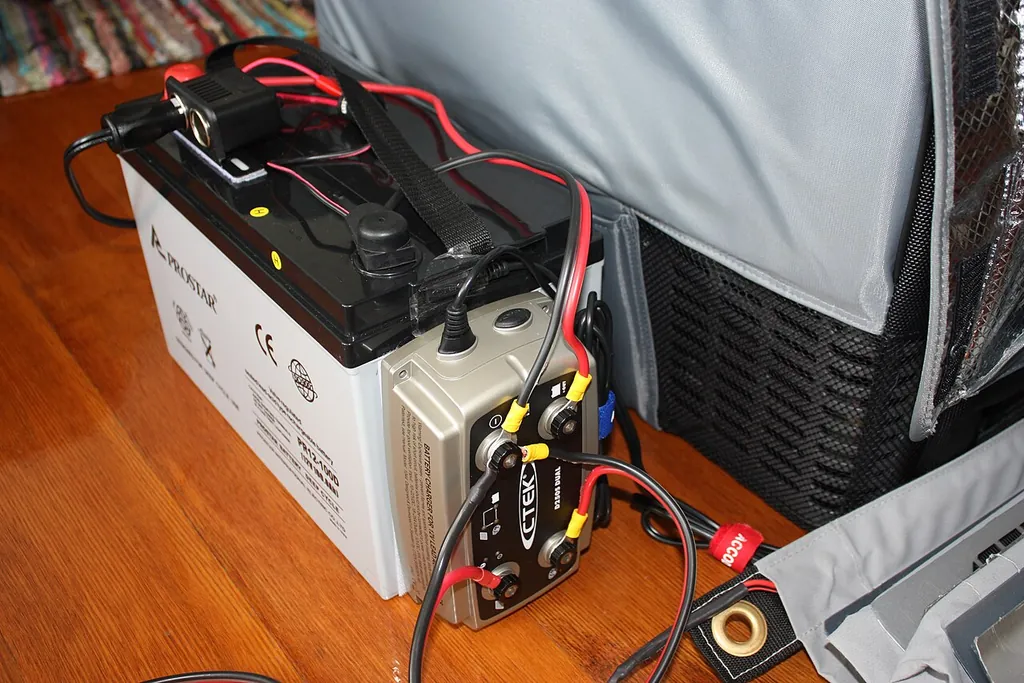
Voltage
The nominal voltage. Lead-acid batteries come in 6, 8 and 12 volts for most uses. A 12-volt lithium battery is usually listed as 12.8 volts, because LiFePO4 cells are about 3.2 volts each and there are four of them.
Amp-hours (Ah)
How much the battery stores. For lead-acid, it is usually measured at the 20-hour rate (C20): the current that drains the battery in 20 hours. Draw it faster and you get less. Lithium ratings hold up much better at high current.
Reserve capacity (RC)
The minutes a lead-acid battery can supply 25 amps before dropping to 10.5 volts. Common on marine and dual-purpose batteries. Higher is better for running loads.
CCA and MCA
Cranking ratings, for starting engines. CCA is measured at 0°F and MCA at 32°F, which is why MCA is the bigger number. A pure deep-cycle battery may not list either. See marine cranking amps vs CCA.
Cycle life
Some labels or spec sheets list a cycle life at a stated depth of discharge, such as a number of cycles at 50 or 80 percent. Compare like with like. A cycle count at 50 percent depth is not the same as one at 100 percent.
Lithium specs to look for
- Continuous discharge current. The most the BMS will let the battery deliver for long. Your trolling motor, inverter or cart must stay under it.
- Peak or surge current. A short burst limit, for a few seconds.
- Charge voltage and charge current. What the charger should be set to.
- Low-temperature charge protection. Whether the battery stops charging when it is cold.
- Series and parallel limits. How many of that battery the maker allows in series or parallel.
Date codes
Lead-acid batteries lose charge on the shelf. Most carry a date code, sometimes as a sticker with a month and year, sometimes a stamped code. A battery that has sat for a long time may need a full charge before it goes in, or may already have lost some life.
Bring the label
When you call, a clear photo of the label on your current battery answers most of our questions in one go.
Related questions
Which number matters most for a trolling motor?
Amp-hours, and for lithium, the continuous discharge current.
What does C20 mean?
The amp-hour rating measured over a 20-hour discharge.