Voltage is a poor fuel gauge
On lead-acid, resting voltage gives a rough idea of charge, but only after the battery has sat for hours with nothing connected. Under load or while charging, the reading jumps around.
On lithium iron phosphate it is worse. LFP voltage stays almost flat from nearly full to nearly empty. A reading of 13.2 volts could mean most of the capacity is left, or much less. You cannot tell from the voltage alone.
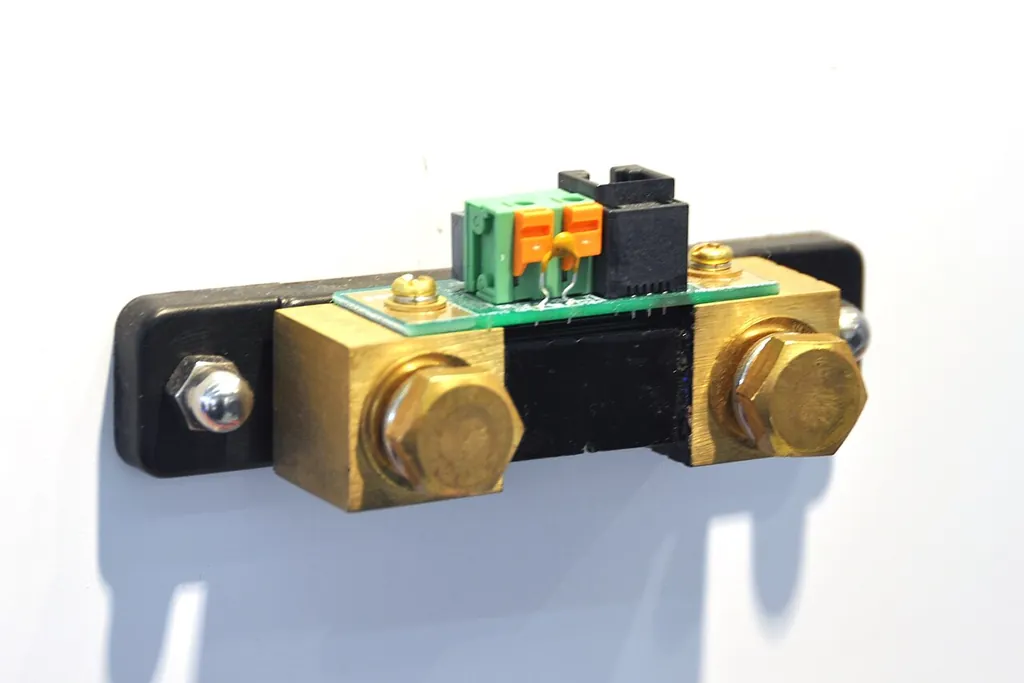
What a shunt does
A shunt is a heavy metal bar with a very precise, very low resistance. All the current going into and out of the battery (except to the starter, on some setups) passes through it. The monitor measures the tiny voltage across it and works out the current. By adding up current over time, it counts amp-hours in and out, like a fuel gauge.
It shows:
- State of charge as a percentage.
- Current right now: what you are drawing or charging.
- Time remaining at the present draw.
- History, such as the deepest discharge and the number of cycles.

Setting one up
- The shunt goes on the negative side, between the battery bank and everything else. Every load and every charger must connect on the system side of the shunt. Anything wired straight to the battery negative is invisible to the monitor.
- Enter the bank capacity and the chemistry.
- Let it synchronize to 100 percent after a full charge. It does this from the charge voltage and current settings.
Lithium batteries with apps
Many lithium batteries report state of charge from their own BMS through Bluetooth. That works for one battery. For a bank of several, or a system with several charging sources, a shunt monitor gives one clear number for the whole bank.
What we install
Shunt monitors on boat house banks, trolling motor banks and RV house banks, wired so every load and charger goes through the shunt. On golf carts, a state-of-charge meter matched to the lithium battery.
Related questions
Why is my monitor wrong?
Usually something is wired to the battery negative instead of through the shunt, or the capacity setting is wrong, or it has not synced after a full charge.
Do I need one on a golf cart?
A lithium golf cart needs a state-of-charge meter. The old lead-acid gauge will not read it properly.